
Bravo! In February 2026, the City of Vancouver published its ‘Rain City Green Roof Best Practices Guide’. Kudos to the team who coordinated this document, and to the subject matter experts who submitted content and reviewed it (which included several members of the GRIN board). This document can serve as a blueprint for potential policy implementation. It also acts as a North Star for policies / plans that relate to green roof implementation. Download the Guide for free HERE.
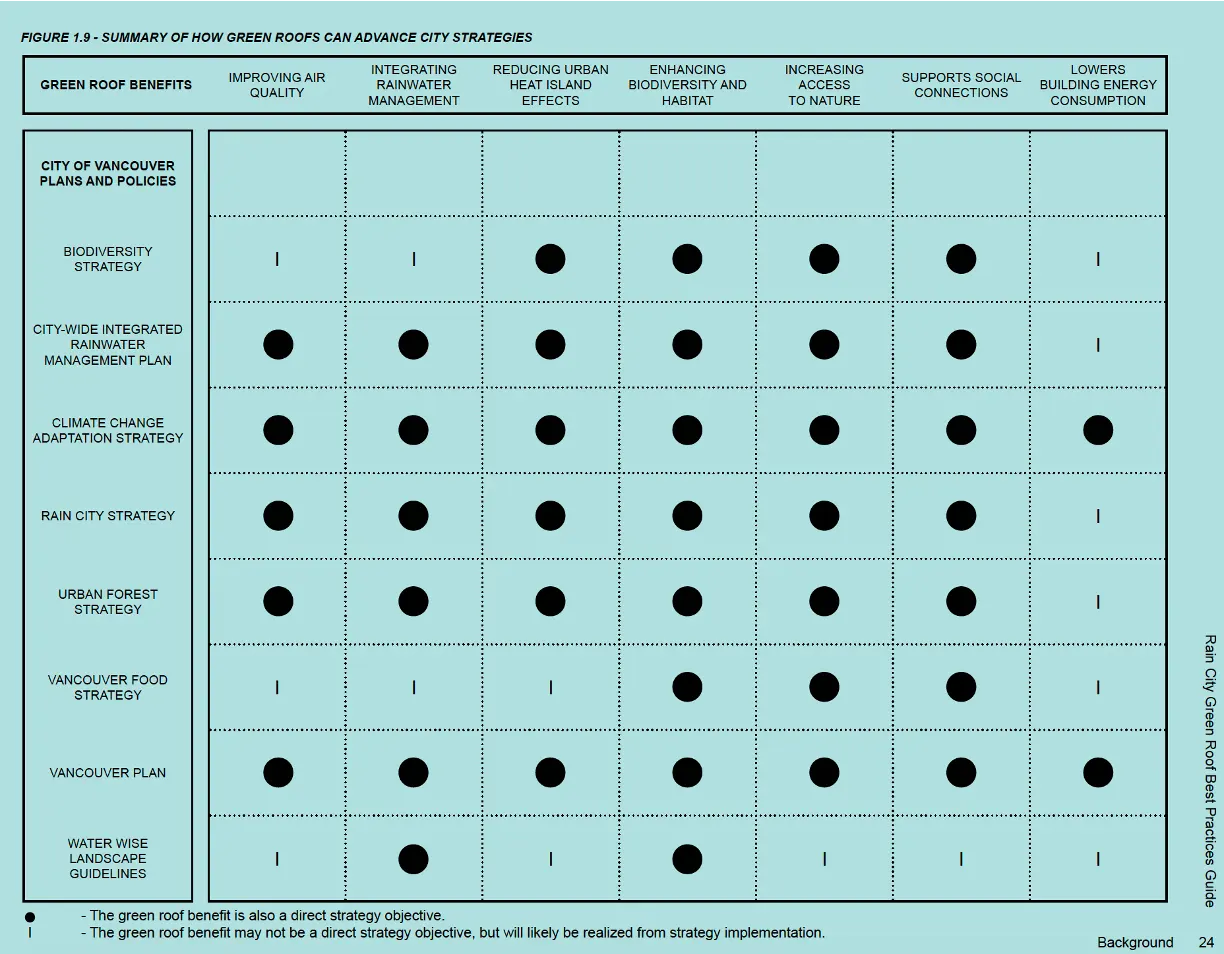
The Guide can help the City address some major challenges to its liveability and resilience. Notably, it’s known that cities that promote widespread implementation of green roofs can elegantly resolve or lessen pervasive issues like stormwater runoff, water and air pollution, urban heat, biodiversity loss, and other issues related to land development, densification, and climate change. As shown in the policy matrix below, excerpted from the Guide, green roofs advance numerous City of Vancouver Plans and Policies.
In addition to technical aspects, the Rain City Best Practices Guide also features content dedicated to habitat enhancement and biodiversity, and expresses the City of Vancouver’s commitment to biodiversity and connectivity. Notably, the Recommended Green Roof Plant List (Appendix A) prioritizes native plant species that support pollinators and contribute to local ecosystem health. In Appendix B, the Habitat Enhancement Guide educates practitioners about how to design for biodiversity in a good way.
We rejoice in the publication of this Guide, and the City’s commitment to green roofs, connectivity, and biodiversity! At the same time, we’re patiently waiting for the green roof mandate that was promised 8 years ago. According to our notes,
In 2018 City of Vancouver Council unanimously approved the exploration of a mandatory green roof policy (vote #03245 pt.15). In 2024, and then again in January 2026, the City updated its Rainwater Management requirements, emphasizing the role that green roofs can play in meeting stormwater management targets onsite. Green roofs are clearly recognized as useful or effective tools to keeping Vancouver healthy, liveable, and resilient.

So: where is the mandate? When can we hope to see this emerge?
Widespread implementation is key to receiving the full benefits of green roofs. For example, while the residents of a green roofed building will benefit from thermal insulation and cooler temperatures in summer, the urban heat island can only be properly reduced (for everyone) when green roofs cover every flat roof. The same applies to stormwater mitigation, and other urban issues. Our advocacy is inspired by other cities, and seeing what is possible.
Green roofs can provide numerous co-benefits, all at the same time. Further to cooling the urban heat island and retaining / detaining stormwater, green roofs can offer amenity spaces, childcare, provide access to nature, and educational opportunities. Green roofs can serve for urban agriculture, and can enhance solar power generation. They can reduce the spread of fire by extinguishing embers.
Get in touch if you’d like to get involved with GRIN. We envision a future where BC’s land- and roofscape are covered by regenerative ecosystems, plants and soils that create conditions that promote reconciliation, food security, and that allow all living beings to thrive. Join us!