
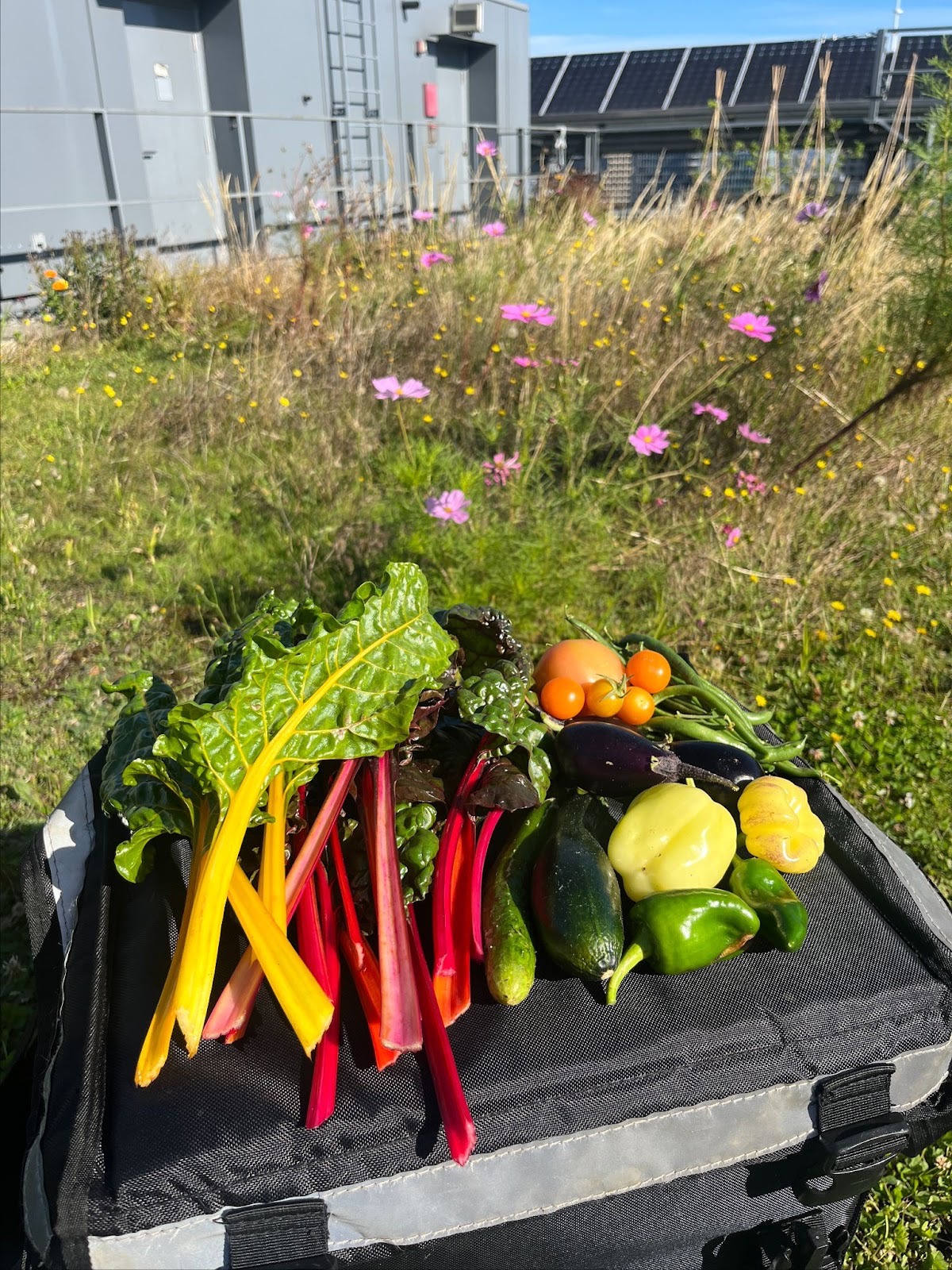
Editor’s note: We’re pleased to share this contribution by Aleka Toogood, who is both a GRIN volunteer and the Regional Lead of the Canadian company, Microhabitat, which manages the world’s largest network of urban farms. Enjoy the post, and please leave a comment below!
As urbanization grows exponentially worldwide, Metro Vancouver’s population is expected to reach 4 million by 2047, rising by 42,000 people annually. As cities grow denser, there is inevitably less room for trees, green space, and gardens. Similarly, with peri-urban development, there is less room for local food production. It is estimated that Canada loses roughly 20,000 hectares of farmland to urbanization each year. As urbanization accelerates, food insecurity continues to rise year on year.
How do we rethink expanding cities whilst also addressing food insecurity? We find alternatives through urban agriculture, and an obvious solution to these trends.
The metropolis of downtown regions, filled with unused roof space and empty rooftops, presents a tantalizing opportunity: using underutilized spaces for urban agriculture. Urban agriculture can mean many things, including on rooftops, balconies, vacant lots or on grass verges. This article focuses on rooftop farming in dense urban settings, specifically downtown Vancouver and Montreal.
In Canada, approximately 60% of consumed vegetables and 80% of consumed fruits are imported, on average, travelling 2500km. Consequently, the distribution of fruits and vegetables contributes significantly to CO2 emissions under the term ‘food miles,’ accounting for 25% of total food mile-related emissions in Canada annually.
Creating local, sustainable food systems can help achieve critical progress toward the Sustainable Development Goals and build more resilient communities by reducing reliance on vulnerable food supply chains. The last 5 years have highlighted the fragility of our food systems and promoted reflection on how to build a more resilient society.
Rooftop Agriculture and Food Security in Canada
Rooftop agriculture has gained popularity as city dwellers see the benefits of being close to nature, offering the opportunity to transform food systems in dense urban settings. Rooftop farms are elevating the skylines across cities in Canada. Yet, quality food production is only one aspect of rooftop agriculture. Rooftop farms and agricultural spaces are also frequently used for educational purposes, such as the Indigenous Foodways Program or for University Programs. They can be instigated by businesses, schools, NGO’s, residential property owners, municipalities or shopping centres. For example, two Canadian Universities are exploring rooftop agriculture:
MicroHabitat Farms in BC
MicroHabitat is a Canadian company and the world’s largest network of urban farms. As of 2026, Microhabitat operates 28 urban farming projects across Metro Vancouver and Victoria through its turnkey service. MicroHabitat offers a non-intrusive option that enables urban farming on a property without making any permanent changes to the building. The farms are designed with advanced technology that does not compromise load-bearing capacity.
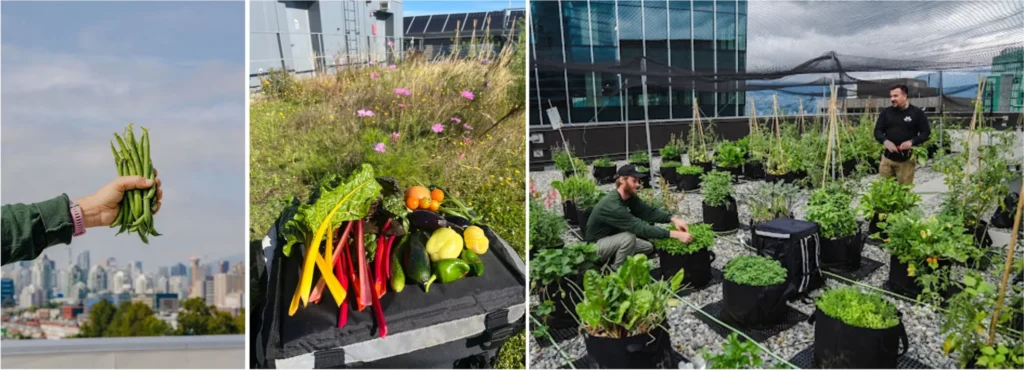
This MicroHabitat urban farm is located in downtown Vancouver, with two Urban Farmers tending to maintenance and harvest
The MicroHabitat ethos emphasizes ecological farming and aims to connect people with the food system. Throughout 2025, over 50 workshops were held across British Columbia to educate the public on urban farming. The workshops are frequently held at the rooftop farms, providing participants with hands-on experience harvesting nutritious vegetables.
Each farm has different varieties of vegetables, herbs and flowers. Harvest weight can vary by farm size. A larger farm, such as Amazon’s “The Post,” produced more than 1,000 lbs in 2025. The produce from MicroHabitat farms is either donated to the tenants or to the community through food banks such as the FoodStash Foundation. In 2025, the high-quality produce donated through this partnership reached over 280 food-insecure households within Metro Vancouver.

Soprema Rooftop Farm in Montreal
Soprema is a global leader in providing innovative, sustainable and high-performance products for waterproofing, insulation, soundproofing and vegetated roofing. In 2016, Soprema worked with IGA Marche Duchemin to create a greenroof system for growing produce.
The IGA Duchemin Organic Rooftop Farm in Montréal, originally designed as a conventional green roof to meet municipal regulations, evolved into a 31,000 ft² rooftop farm producing over 30 types of vegetables and flowers. Using the SOPRAFLOR system, the rooftop Farm in Montréal was created using a semi-intensive system, featuring mid-light green roofs ranging from 150 mm to 300 mm in depth of SOPRAFLOR growing media.
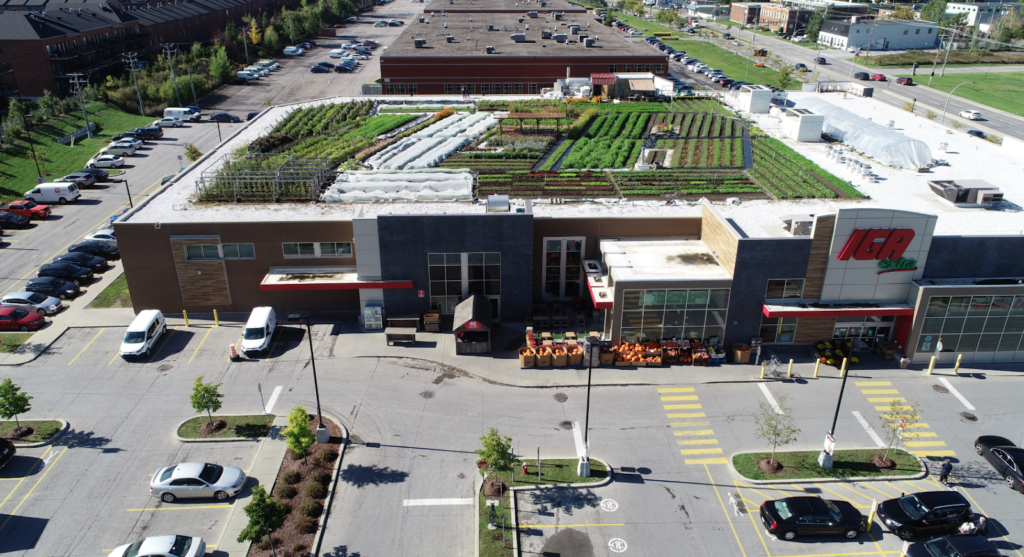
Aerial shot of the IGA rooftop farm located in Montreal
At the time, IGA Duchemin was the first grocery store in Canada to sell fresh organic produce harvested directly from its roof. This single rooftop farm provides between 35,000 and 40,000 units of food, flowers, and honey each year, which is sold in the store below. The only means of transportation required to get the produce from the roof to the market is the 44 steps that connect the farm and the store.
Since the project opened in 2017, the operational model has evolved and has now partnered with the non-profit organization La Ferme de Rue Montréal to support the long-term viability of the project. Whilst this project is a one-off, it demonstrates the use of underutilized space in urban settings.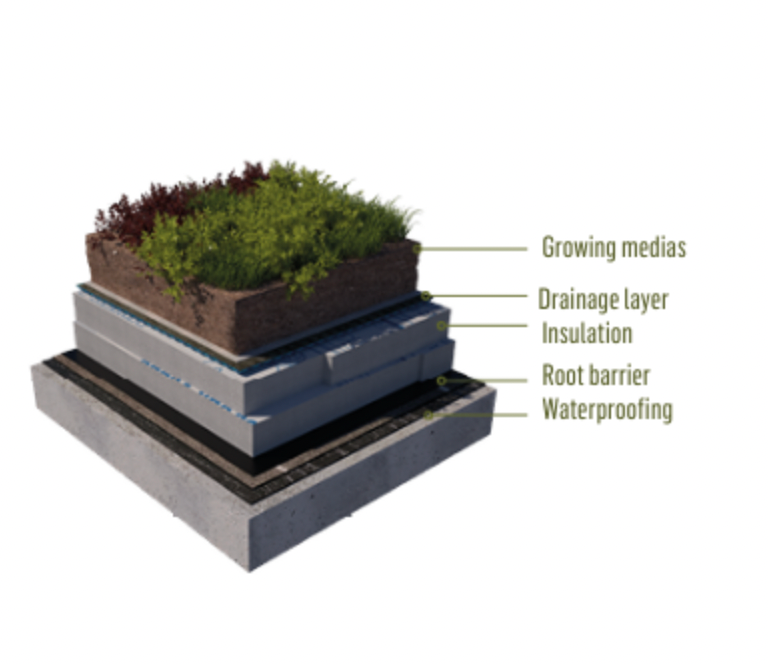
In conclusion
What’s evident from these companies is that different business models are available to support urban agriculture. Research has found that the motivation for urban agriculture favours social, health-related, educational and sustainability benefits. This differs from traditional agriculture, where maximizing yields is often the driving factor.
Next time you are walking around your city, keep an eye out for urban agriculture. Think to yourself: Is there potential to transform this underutilized space into a thriving urban farm?
Join us in Summer 2026 as we explore rooftop farming in downtown Vancouver, highlighting resilience, food security and smarter urban design. GRIN is pleased to collaborate with MicroHabitat on its first green roof agriculture tour in July 2026. Join our mailing list to be the first to find out about this unique tour, and receive other GRIN news straight to your inbox! 
Do you want to gain work experience in Urban Agriculture in Vancouver? MicroHabitat are looking for team members to help with installations in May 2026. Check out this unique opportunity here.
We’d love to hear from you. How did you find this article impacted your understanding of urban agriculture and the options available? Use the comments below.
Biography
Originally from Wales, Aleka holds a Master’s Degree in Sustainability and Adaptation from the Centre of Alternative Technology, with a focus on climate adaptation planning and climate risk. Throughout her career in environmental roles, she has consistently advocated for nature-based solutions that support climate adaptation and ecological health.
After relocating to Vancouver, Aleka pivoted into urban farming. Having studied permaculture design and worked on many permaculture projects across the globe. Aleka is passionate about connecting communities to local food systems and promoting ecological farming practices. Aleka leads the MicroHabitat urban farming team in British Columbia and recently joined the GRIN board.